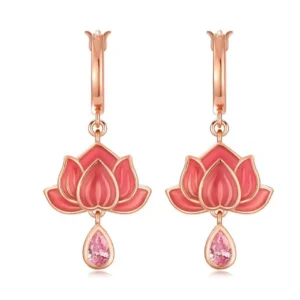
Light brings a gemstone’s color and facets to life. Refractive index (RI) helps explain how light travels through the material and gives gemologists a useful identification clue. Reading that number alongside cut, transparency and other observations offers a clearer understanding of the stone—without asking one measurement to tell its entire story.

What is the Refractive Index of Gemstone?
Refractive index (RI) is the ratio of the speed of light in a vacuum to its phase velocity in a material, at a specified wavelength. Diamond’s value of about 2.42 is higher than quartz’s value of about 1.54. That difference is useful in understanding refraction, but it does not by itself rank the sparkle of two finished stones. Cut, polish, lighting and viewing conditions also affect what we see.
Why does the Refractive Index Vary?
Refractive index depends on a material’s composition and structure, as well as the wavelength of the light used for measurement. This is why reference values need a consistent measurement context. A number can help identify a material, but it does not by itself explain its transparency, color or overall brilliance. Nor should a change in color after treatment be assumed to mean that the stone has acquired a completely different RI.
What is Double Refraction?
Many crystalline gems are doubly refractive: light can propagate with different refractive indices depending on direction and polarization. The difference between the principal indices is called birefringence. Visible doubling depends on the stone and viewing direction; it is not equally apparent in every view. Cutters consider these optical properties when choosing a stone’s orientation.

How to Measure the Refractive Index of Gemstones?
A gemological refractometer measures refractive index using a suitable polished surface and contact liquid. Rotating a doubly refractive stone can reveal different readings; the difference between the maximum and minimum readings is birefringence, not dispersion. The instrument and contact liquid limit the measurable range: a conventional model reaching approximately 1.81 cannot directly measure the RI of diamond or moissanite. An over-the-limit result is a limitation of the test, not proof of a stone’s identity.
Practical Applications in Gemology
Material identification: RI can help distinguish materials such as spinel and corundum when combined with other observations. It does not, by itself, distinguish a natural gem from a laboratory-grown counterpart of the same material.
Cut Optimization: High-RI stones like Moissanite (RI 2.65–2.69) demand precise facet angles to maximize light return.
Treatment assessment: Fracture fillers can make breaks less visible. Identifying a filler requires suitable examination; a routine RI reading alone does not establish whether an emerald has been treated.
Gem Treatments and Optical Appearance
Treatments can change a gem’s appearance without making its bulk refractive index a simple test for authenticity. The following examples describe different mechanisms, not a method for turning one gem species into another.
Fracture filling: Oils, resins or glass may reduce the visibility of surface-reaching fractures. The material and extent of filling matter when describing and caring for a gem.
Surface coatings: A thin surface layer can alter appearance. Its optical effect should not be confused with changing the identity of the material beneath it.
Diffusion treatment: Elements can enter a gemstone during heating to modify color, as in some treated corundum. This differs from applying a surface coating. See GIA’s introduction to gem treatments for examples and detection limits.

Refractive Index in Gemstone Identification
Refractive index helps narrow down a gemstone’s identity, but it is one observation in a broader examination. Different materials can have overlapping readings, and a laboratory-grown gemstone can share the optical properties of its natural counterpart. RI alone does not establish natural origin, geographic origin or the absence of treatment. Gemologists combine suitable tests and, where necessary, laboratory analysis to reach an identification.
| Gemstone | Refractive Index Range | What RI Can Indicate |
| Ruby | 1.762–1.770 | Helps narrow material identification; not proof of natural origin |
| Emerald | 1.577–1.583 | Supports identification with other tests; not a treatment test alone |
| Sapphire | 1.762–1.770 | Consistent with corundum; does not establish geographic origin |
| Opal | 1.37–1.47 | Must be combined with other observations to assess identity |
Gemstones with High Refractive Index
A high refractive index affects how light refracts at a gem’s surfaces, but it does not guarantee exceptional brightness or fire. Fire refers to flashes of spectral color associated with dispersion—the variation of refractive index with wavelength. Cut and viewing conditions influence how these effects appear in a finished gem. Examples include:
Diamond (RI: about 2.42): Its brightness and fire depend on the interaction of material properties with facet proportions, polish and lighting. A high RI alone is not a cut-quality grade.
Moissanite (RI: 2.65–2.69): It has a higher RI than diamond and is doubly refractive. Facet doubling may be visible from suitable directions, so the viewing direction matters when examining it.
Ruby and sapphire (RI: 1.762–1.770): Both are corundum. Their RI range is useful for identification, but it does not grade color saturation or establish a stone’s value.
The linked GIA references provide representative values, not the full limits of every composition or specimen. Birefringence ranges are reported separately and should not be calculated by subtracting the endpoints of a range covering different stones. Aggregate and organic materials need suitable testing methods; a missing value here does not mean the material has no optical complexity.
| Gemstone | Reference RI | Birefringence | Reading the Values |
|---|---|---|---|
| Diamond | 2.42 | None | High RI does not distinguish natural from laboratory-grown diamond. |
| Ruby | 1.762–1.770 | 0.008–0.010 | Corundum; treatment assessment needs additional examination. |
| Sapphire | 1.762–1.770 | 0.008–0.010 | Corundum; RI alone does not establish geographic origin. |
| Spinel | 1.718 | None | Typical reference value; composition can affect measured values. |
| Demantoid Garnet | 1.880–1.889 | None | Above the range of a conventional contact refractometer. |
| Emerald | 1.577–1.583 | 0.005–0.009 | RI alone does not establish geographic origin or treatment. |
| Aquamarine | 1.577–1.583 | 0.005–0.009 | Beryl; reference values are not a clarity grade. |
| Topaz | 1.619–1.627 | 0.008–0.010 | Care must account for cleavage as well as hardness. |
| Tourmaline | 1.624–1.644 | 0.018–0.040 | Composition affects optical properties; values are a reference. |
| Peridot | 1.65–1.69 | 0.035–0.038 | Birefringence can produce visible facet doubling. |
| Tanzanite | 1.691–1.700 | 0.008–0.013 | RI alone does not establish whether a stone has been heated. |
| Opal | 1.37–1.47 | None | Play-of-color is a different optical phenomenon from RI. |
| Jadeite | 1.666–1.680 (±0.008) | Usually not detectable in aggregate | Aggregate material; do not treat a spot reading as two resolved indices. |
| Amber | 1.540 | Not listed in source | Organic material; this typical value is not an authenticity test alone. |
| Cubic Zirconia | 2.15–2.18 | None | Manufactured diamond simulant; distinct from laboratory-grown diamond. |
| Pearl | 1.52–1.69 | Not listed in source | Layered organic gem material; not a routine faceted-stone reading. |
The Takeaway
For gemstone jewelry, refractive index helps explain how light behaves within a stone and provides a useful clue in identification. It should be read alongside other observations rather than used as a stand-alone authenticity test. Natural and laboratory-grown gems can share optical properties, while brilliance and fire also depend on factors beyond a single RI value. Understanding those limits makes the numbers more useful when comparing gemstones.