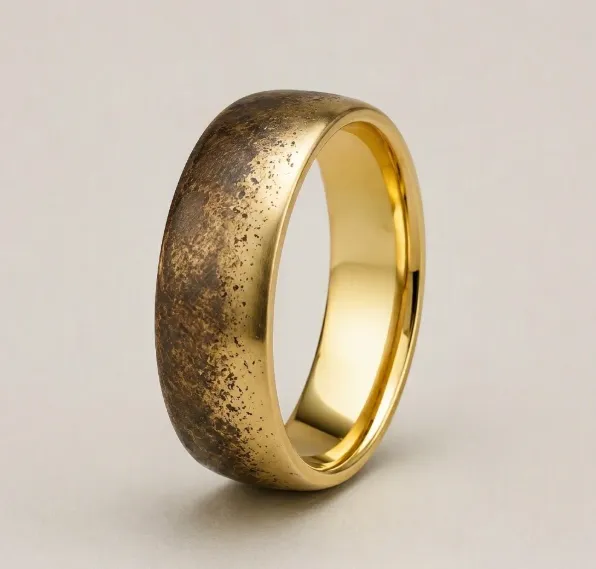
A brass ring can look flawless in a supplier’s sample photo and come back as a return three weeks after your customer starts wearing it.
So, does brass jewelry tarnish? Yes. The copper in the alloy reacts with air, moisture, and skin acids, and the surface gradually darkens. But the timeline is not fixed: raw brass can show discoloration within weeks of daily wear, plated brass holds up far longer, and plated brass with an e-coating barrier lasts longest. How fast it happens comes down to choices you make at the sourcing stage.
This guide explains why brass tarnishes, how long each finish realistically lasts, and what to write into your purchase order so the pieces you sell stay sellable.
Why Brass Tarnishes (and Why It Never Rusts)
Brass is an alloy of copper (typically 60-70%) and zinc. Copper is the part that reacts: when it meets oxygen, moisture, and the mild acids in human sweat, it forms a darker oxide layer — the dull, brownish film people call tarnish. In some conditions the same reaction produces copper salts that can leave a green mark on skin. That mark is harmless, but your end customers will complain about it all the same.
One related question we hear often: does brass rust? No. Rust is specific to iron. Brass contains no iron, so it tarnishes but never rusts — tarnish changes the surface color without weakening the structure of the piece.
What Tarnish Actually Costs a Wholesale Buyer
For a wholesaler or brand owner, tarnish is not a chemistry trivia question. It shows up in your business as returns, one-star reviews, and a boutique client who quietly stops reordering. The frustrating part is the delay: two brass rings can behave completely differently after a month of wear, and by the time the difference shows, the pieces are already on your customers’ hands. Tarnish resistance cannot be inspected in a sample room. It has to be specified into the order, which is what the rest of this guide is about.
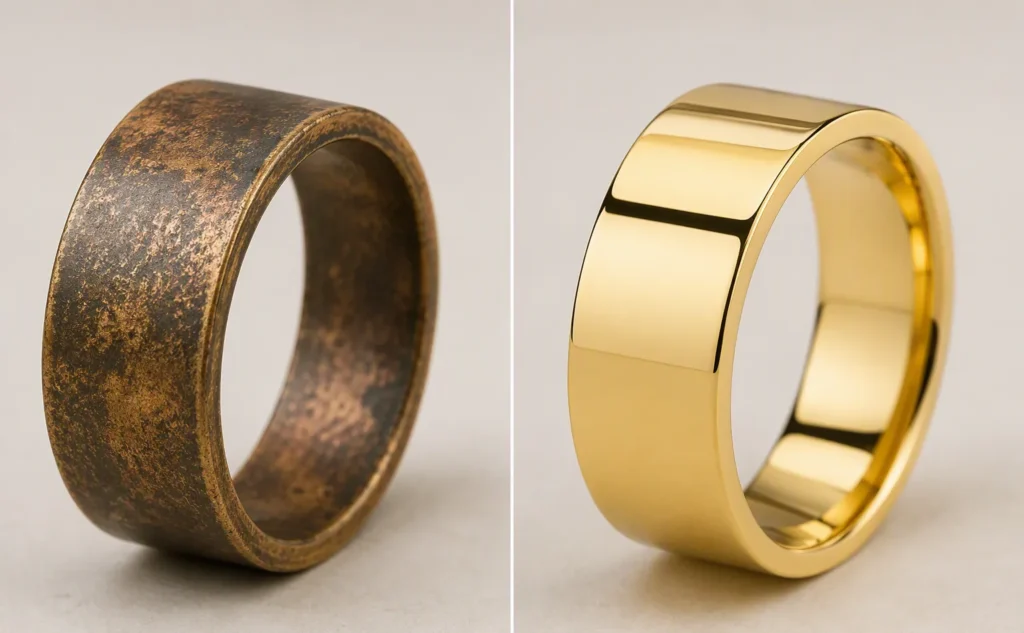
How Long Each Finish Really Lasts: A Realistic Comparison
So how long does brass jewelry last before it tarnishes? There is no single honest number, because wear conditions vary. But after two decades of making jewelry, these are the ranges we consider realistic for daily-wear pieces:
| Finish | What it is | Realistic time to visible tarnish | Best for |
|---|---|---|---|
| Raw brass (unplated) | Polished brass, no coating | Weeks to a few months | Vintage/aged looks, craft market |
| Flash plating (~0.03 µm) | Very thin gold or silver layer | A few months with daily wear | Fast-fashion price points, seasonal lines |
| Heavier plating | Thicker gold/silver layer per buyer spec | Around a year and up | Mid-range retail, repeat-purchase brands |
| Plating + e-coating | Plated, then sealed with a transparent e-coating | The longest of the four; the barrier blocks sweat and moisture | Brands that promise tarnish resistance to their customers |
These are experience-based ranges, so treat them accordingly: humidity and how the end customer stores the piece both move the timeline. What you can control at the sourcing stage is which finish you specify, and whether your manufacturer applies it consistently across a 5,000-piece order.
The Two Specs That Decide How Long the Finish Holds
Does gold-plated or silver-plated brass tarnish? Yes, eventually. The plating slows the reaction; it does not stop physics. Two things decide how long the finish holds:
Plating thickness. A flash layer and a heavy layer look identical on day one and very different on day ninety. Thickness is a cost decision, and a serious manufacturer will quote it as a variable rather than hide it. On our line, plating starts from 0.03 µm for fast-fashion price points and goes up from there, specified per buyer requirement. Tell us the wear life your market expects, and we will spec and quote accordingly.
What sits on top of the plating. An e-coating is a transparent electrophoretic layer that seals the plated surface against sweat, moisture, and oxygen, the three main drivers of tarnish. We apply anti-tarnish e-coating as standard on every brass order we ship, not as a paid add-on. How our e-coating process works →
How Tarnish Resistance Is Built on the Production Line
Tarnish resistance is built on the production line, not sprayed on at the end. Our sequence for brass orders:
- Multi-round polishing. A mirror base with minimal chemical residue, so the plating bonds evenly.
- Vacuum plating plus multi-layer gold plating. A uniform, bonded coating rather than a single quick dip.
- Anti-tarnish e-coating. Standard on all brass orders, sealing the surface against the elements that drive tarnish.
You can see the full detail on our craftsmanship page. For care instructions you can pass on to your end customers, our anti-tarnish care guide is written for exactly that purpose.
Is Brass Hypoallergenic?
Copper and zinc themselves rarely cause reactions. The real allergen risk in fashion jewelry is nickel, which can appear in base alloys or in plating layers. If you sell into the EU, nickel release is a regulated parameter; in the US, lead content tends to get more attention from regulators.
For buyers with sensitive-market requirements, we offer nickel-free plating options. Tell us which market you are selling into before sampling, and we will advise on the right material and finish combination — it is much cheaper to get this right at the spec stage than after a shipment arrives.
4 Questions to Ask Before You Place a Bulk Order
Buyers who ask these up front avoid most quality disputes later:
- “What plating thickness are you quoting?” If the quote doesn’t state a micron figure, the price is hiding a spec.
- “Is e-coating included, or extra?” Some factories charge it as an add-on; we include it as standard on brass orders.
- “Can you do nickel-free plating for my market?” Ask before sampling, not before shipping.
- “What is your MOQ and sampling lead time?” Ours: 30 pieces per design, samples in 7-10 working days, bulk orders in 10-15 working days.
FAQ: Brass Tarnish and Wholesale Orders
1. Can tarnished brass jewelry be restored or re-plated?
Yes. Tarnish is a surface reaction, so pieces can be re-polished and re-plated. For a retail brand, though, prevention at the factory is far cheaper than restoration after returns.
2. How long does e-coating last?
It depends on wear conditions, but e-coating meaningfully extends the time before visible tarnish compared with plating alone. It is a barrier layer rather than a permanent shield, and we will give you realistic expectations for your specific finish at quotation.
3. Is brass suitable for earrings and rings, or only necklaces?
All of them, but skin-contact pieces benefit most from plating plus e-coating and nickel-free options. Earrings and rings see the most sweat and friction, so we recommend against raw brass for those categories.
4. What is your MOQ and lead time for brass jewelry?
MOQ is 30 pieces per design (10 for complex or high-end custom work). Samples are ready in 7-10 working days after design confirmation, and bulk orders ship in 10-15 working days, with rush options at 7-10.
The Key Takeaway
Tarnish stops being a risk the moment it becomes a spec. Decide the wear life your market expects, put plating thickness and e-coating in writing, and the pieces you sell stay sellable. We build anti-tarnish e-coating into every brass order as standard — if that is the kind of manufacturer you are looking for, browse our brass jewelry capabilities →